Etsy
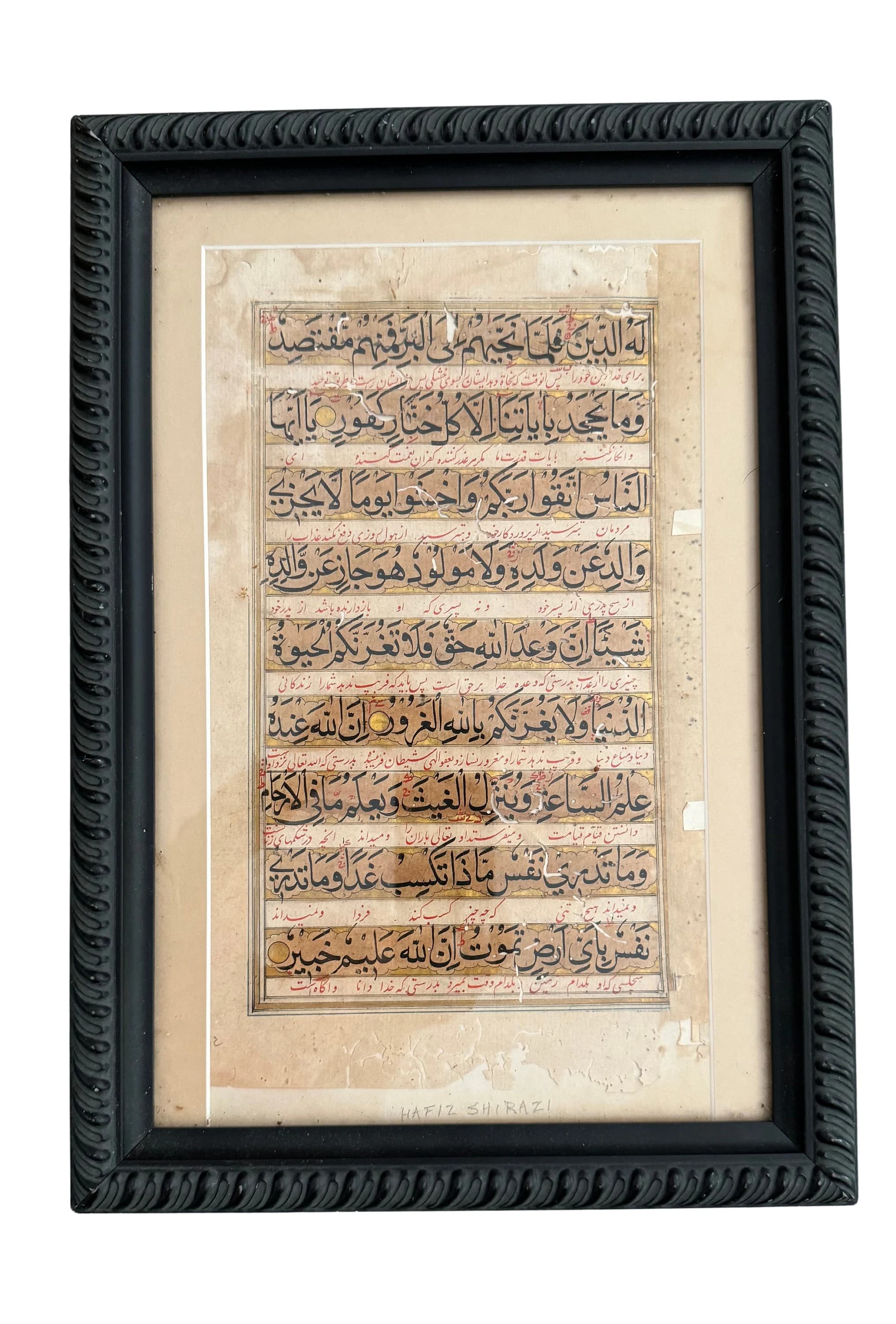
Antique Persian Surah Luqman Quran
$500.00
In stock
Description
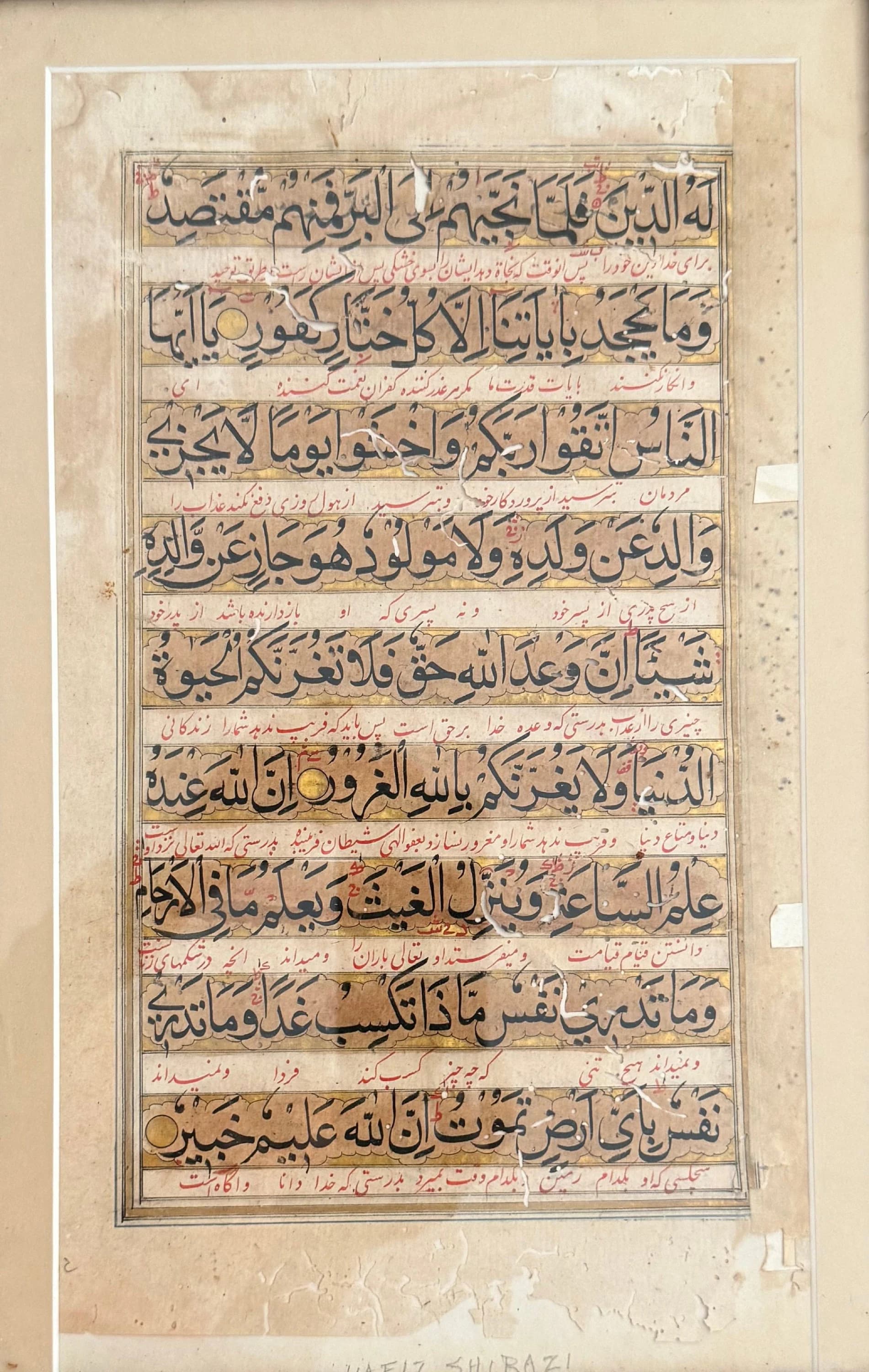
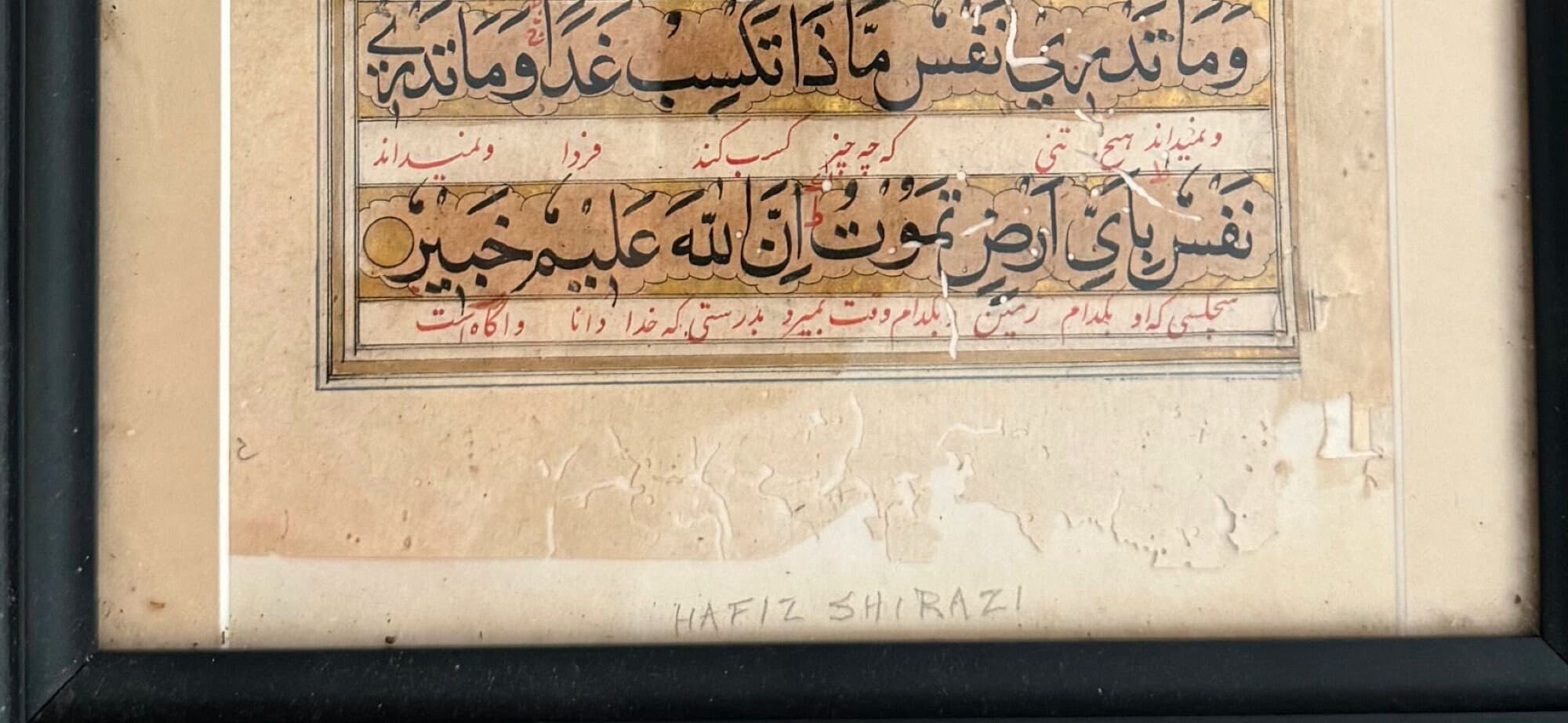
This page is from the Qur’an, Surah Luqman (Chapter 31), verses 32–34, written in large black Arabic script with a red interlinear Persian translation underneath. The note “HAFIZ SHIRAZI” at the bottom is a later handwritten addition (likely a scribe, owner, or misattribution) and is not part of the original text.
Here is a clear English translation of the verses shown:
31:32
And when waves cover them like canopies, they call upon Allah, sincere to Him in religion. But when He delivers them safely to land, some of them are moderate [in faith]. And none denies Our signs except every treacherous, ungrateful person.
31:33
O mankind, fear your Lord and fear a Day when no father will avail his son at all, nor will a son avail his father at all. Indeed, the promise of Allah is true. So do not let the life of this world deceive you, and do not let the Deceiver (Satan) deceive you about Allah.
31:34
Indeed, with Allah alone is the knowledge of the Hour. He sends down the rain and knows what is in the wombs. No soul knows what it will earn tomorrow, and no soul knows in which land it will die. Indeed, Allah is All-Knowing, All-Aware.
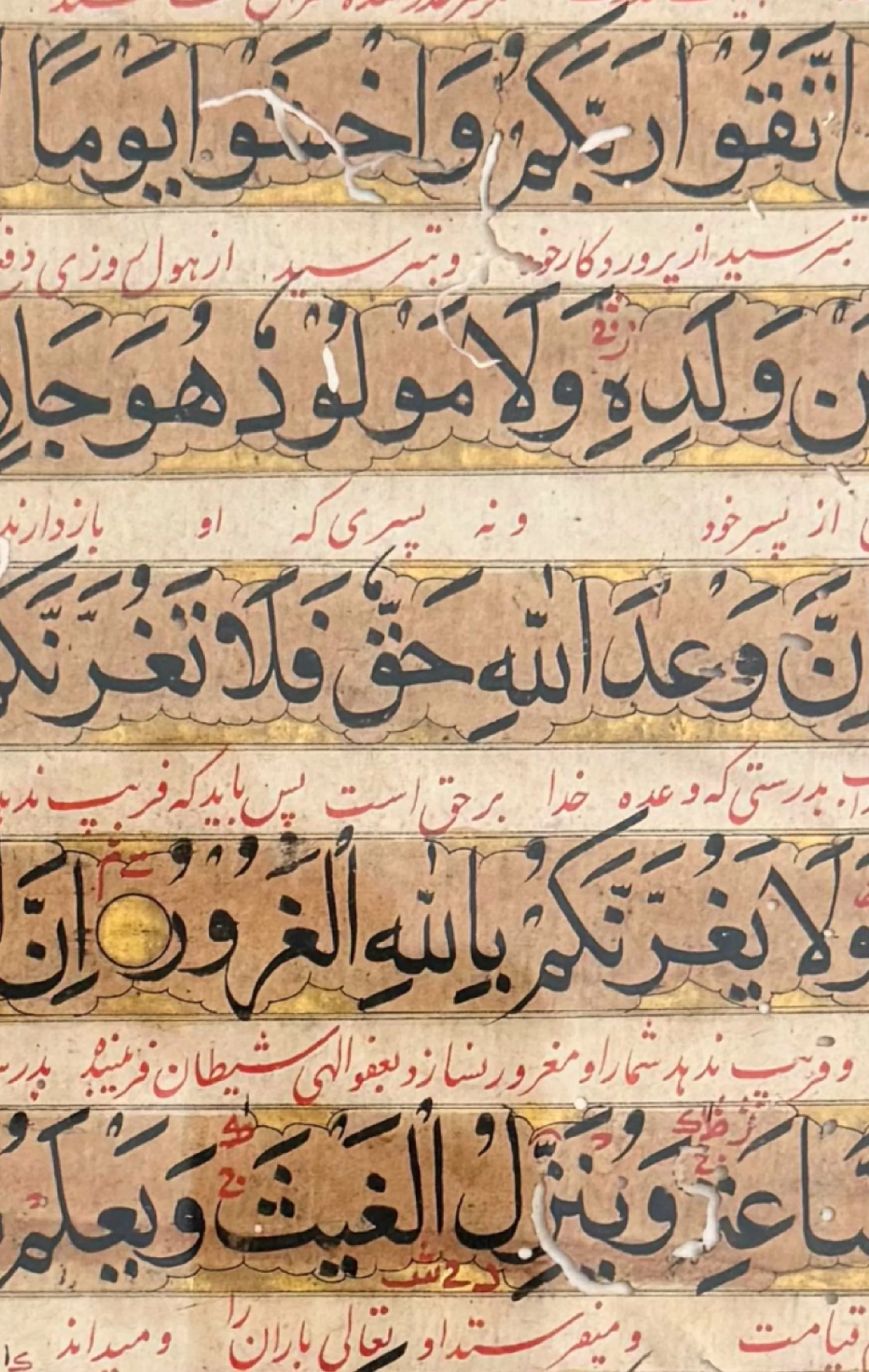
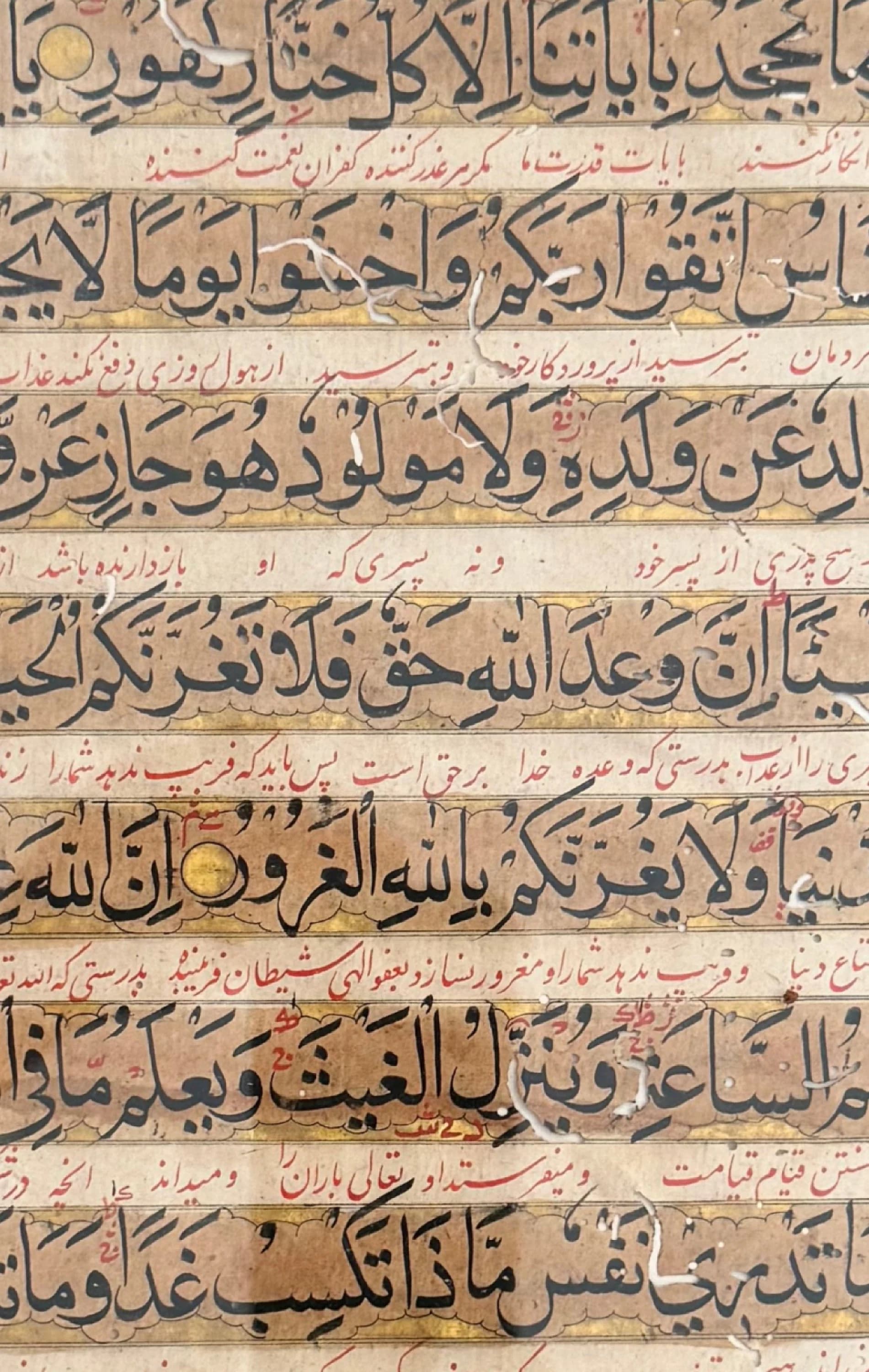
The red lines are a traditional Persian rendering of the same verses (common in older Qur’an manuscripts). They closely follow the Arabic meaning rather than adding independent commentary.
Most likely date: late 17th to early 18th century (roughly 1680–1740), with the strongest probability in the 18th century.
Reasons:
The combination of large black naskh for the Arabic and small red nastaʿlīq for the word-by-word Persian translation, set in alternating gold and plain bands inside gold rules, is a standard Iranian format that became common in the late Safavid period and continued through the Zand and early Qajar eras.
Similar leaves and complete manuscripts of this type are routinely dated by auction houses and collections to the 17th–18th centuries (Safavid Shiraz or Isfahan) .
Measurements (~13 × 8 in / ~33 × 20 cm) and “very thin paper” fit many mid-to-late luxury and semi-luxury Qur’ans of that period. Earlier (16th-century) examples of this interlinear type exist but are usually more heavily illuminated and on slightly different paper.
The staining, foxing, edge wear, and later pencil note “HAFIZ SHIRAZI” at the bottom are consistent with a leaf that has been out of its binding for a long time. “Hafiz Shirazi” here is almost certainly a later owner’s or dealer’s annotation, not evidence that the famous 14th-century poet wrote it.
More in Qurans
View all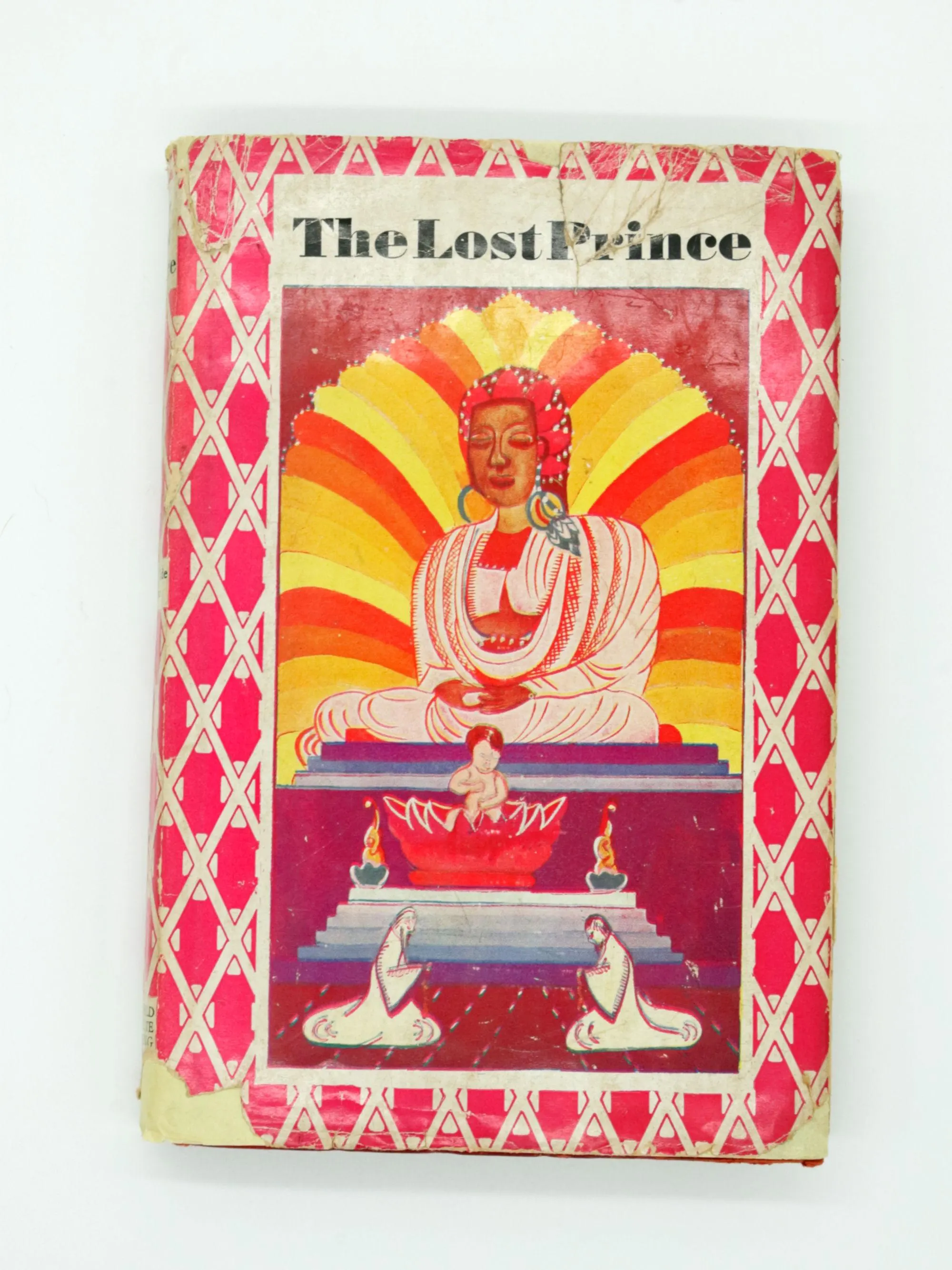
The Lost Prince, by E.J. Craine & Lotta Bacskai | Vintage fiction - 1932
$25.00
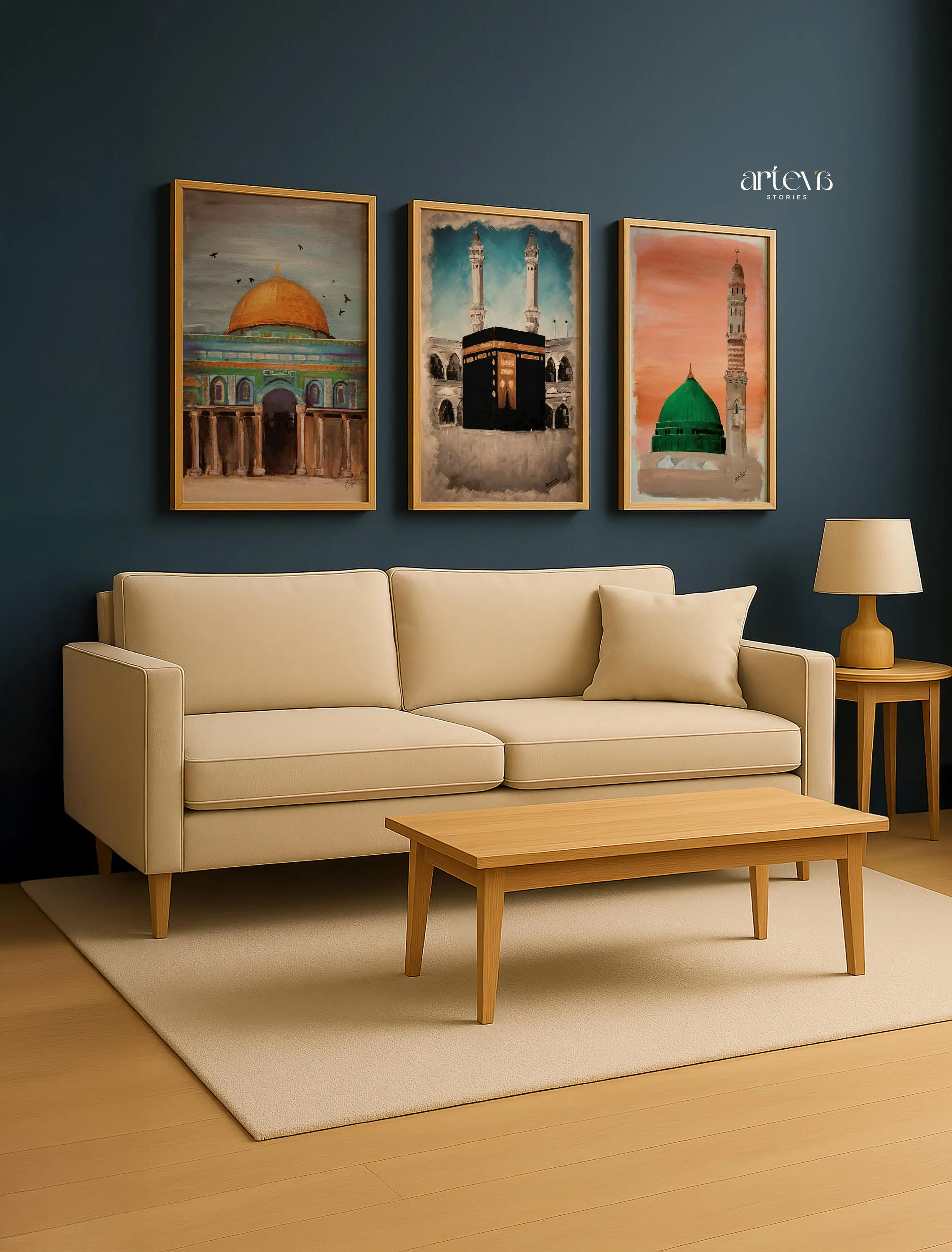
Set of 3 Islamic Landmarks Wall Art, Kaaba Mecca Dome of the Rock Masjid Nabawi, Printable Ramadan Decor Digital Download
$33.20

Islamic Kids Dua Cards Set of 6 Printable | Bedtime Ayat Al Kursi Wall Art | Muslim Children Dua Digital Download | Nursery Decor
$4.00