Home/Home & Decor/Islamic Wall Art/Handmade Islamic Calligraphy Wall Art – Surah Al Ikhlas, An-Nas, Al-Falaq
Etsy
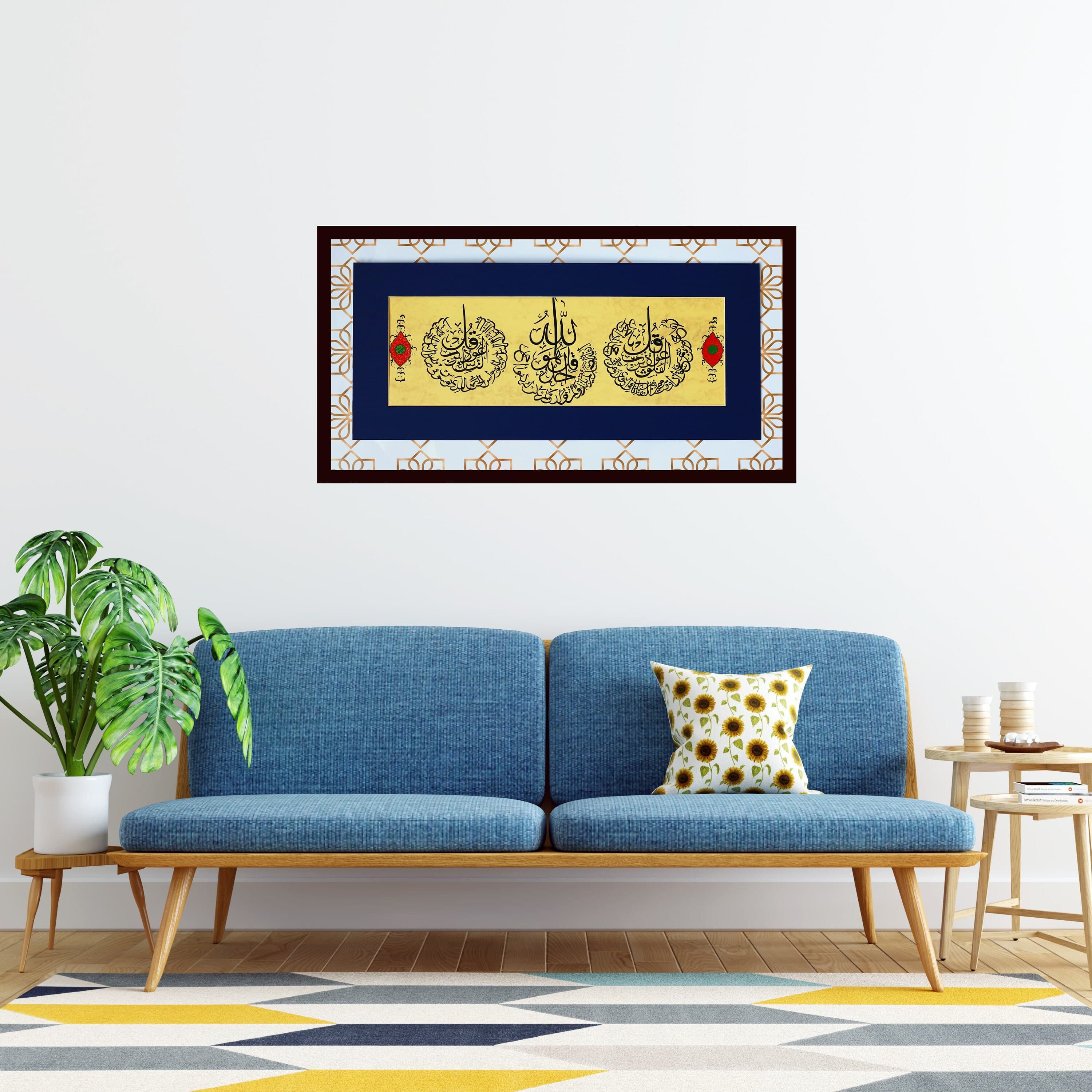
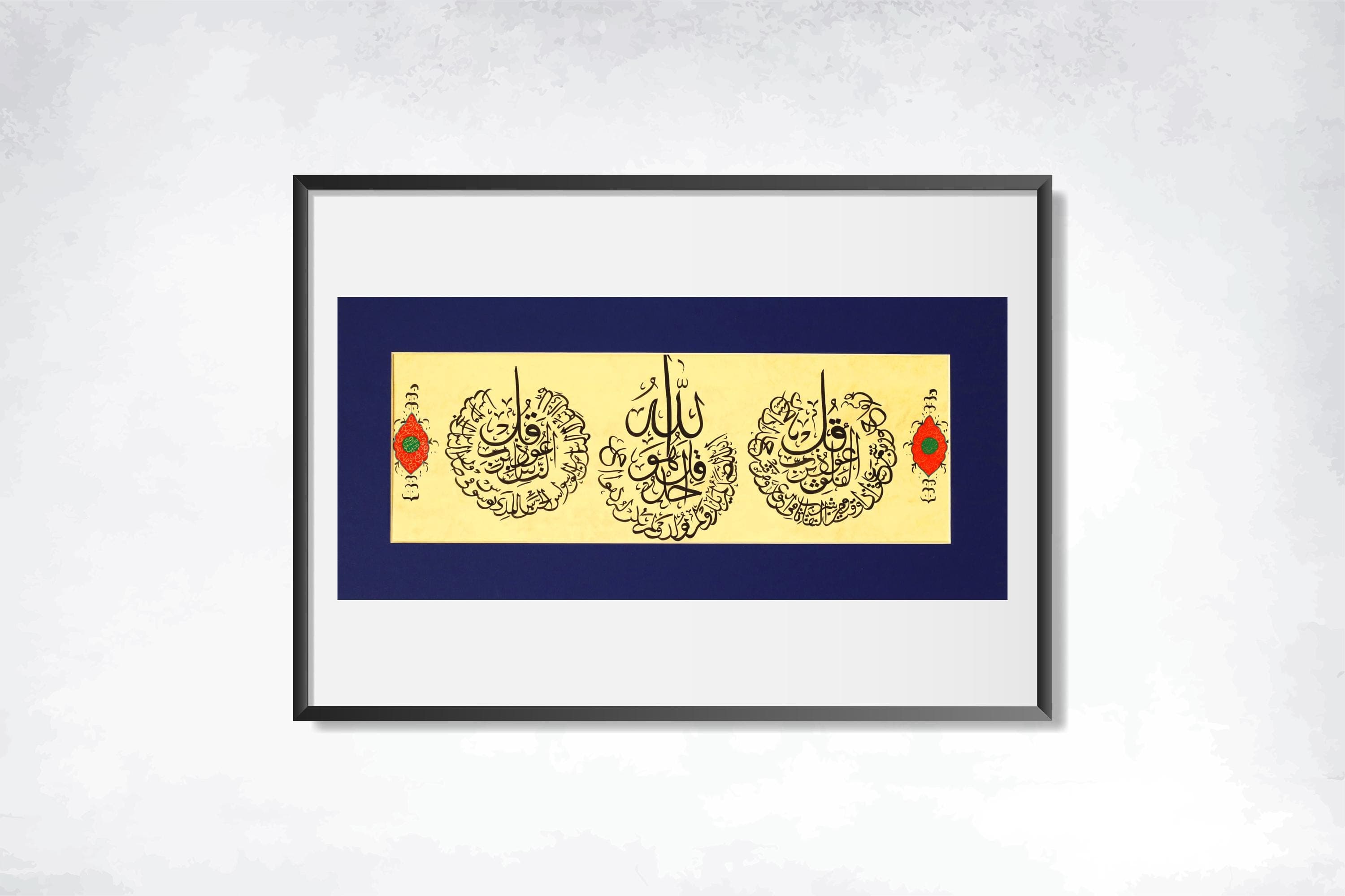
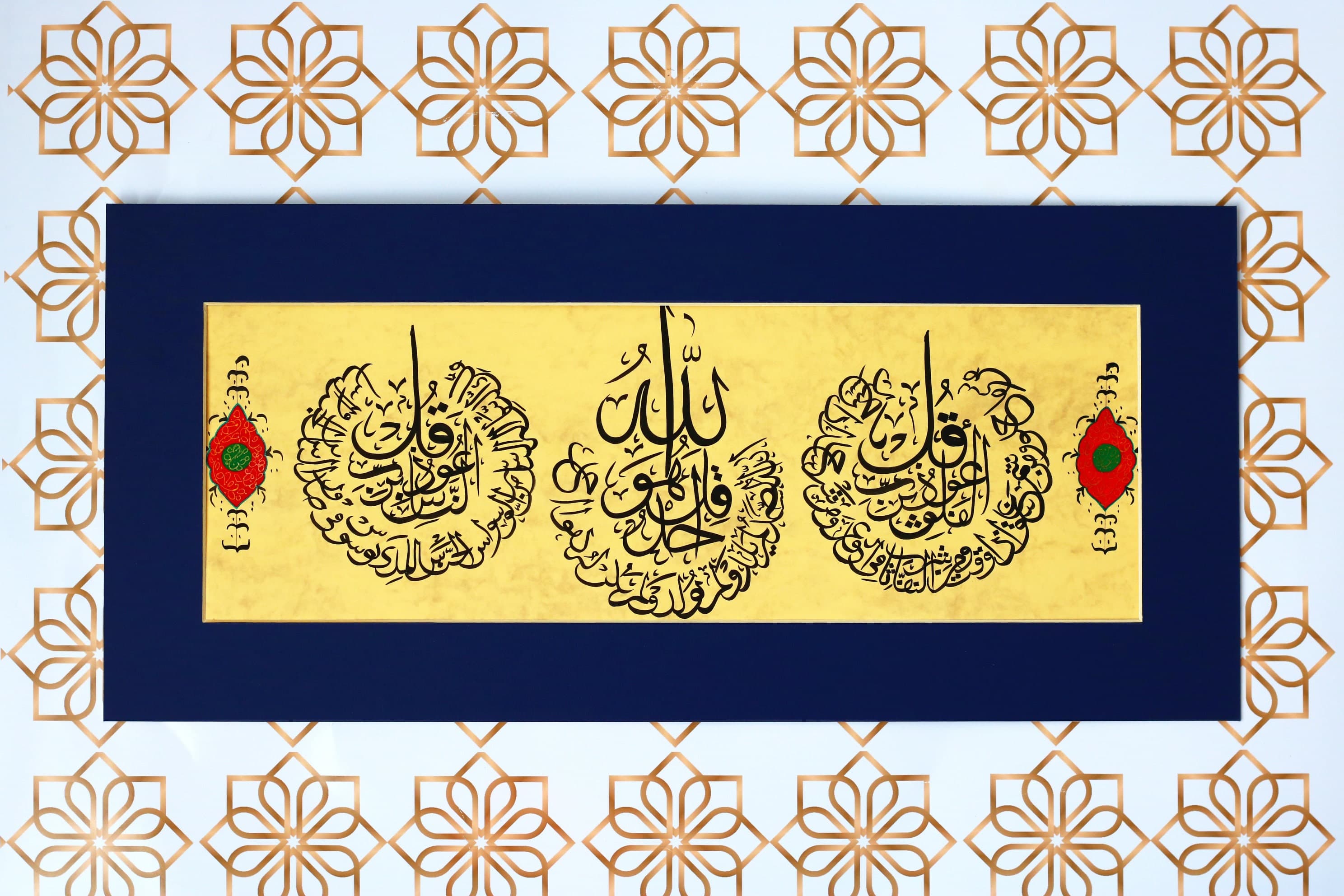
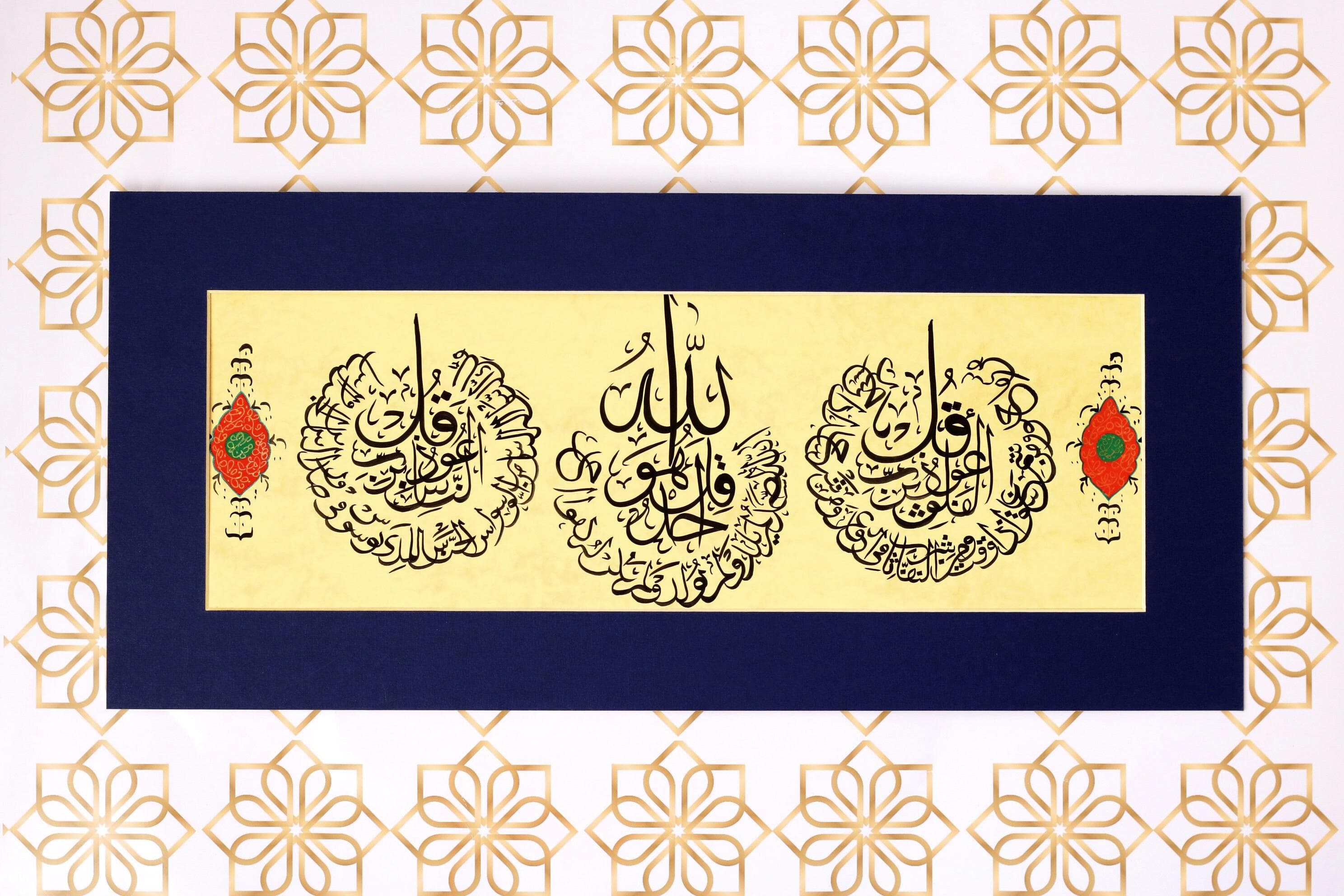
Handmade Islamic Calligraphy Wall Art – Surah Al Ikhlas, An-Nas, Al-Falaq
$209.00
In stock
Description
Original Handmade Islamic Arabic Premium Wall Art Arabic Calligraphy Wall Art Handmade Islamic Gift Ramadan Gift Hand Painting Islamic Art Wall Art Wall Décor "Surah AL Ikhlas -AN Nas AL Falaq"
The painting includes the Arabic calligraphy handwriting of
Introduction
(Revealed before Hijrah)
That this is one of the earliest Meccan Surahs is the view of Hasan, ‘Ikrimah and, above all, Ibn Mas‘ud, one of the earliest of the Holy Prophet’s Companions. However, Ibn ‘Abbas, though much younger than ‘Abdullah bin Mas‘ud but regarded as one of the most learned Companions, thinks that the Surah was revealed at Medina. In view of these conflicting opinions of these two very respected Companions of the Holy Prophet some commentators of the Quran are inclined to think that the Surah was revealed twice, first at Mecca and then at Medina. Among the orientalists, Muir places it among the earliest Meccan Surahs, while Nöldeke assigns it to the end of the first period—about the fourth year of the Call.
In view of the importance of its subject matter, the Surah has come to be known by several names, of which some are: At-Tafrid; At-Tajrid; At-Tauhid, Al-Ikhlas; Al-Ma‘rifah; As-Samad; Al-Athath; An-Nur, etc.
Because it deals with the basic religious belief—Unity of God—the Surah has the distinction of being called by the Holy Prophet as the greatest of all the Quranic Surahs (Ma‘ani). ‘A’ishah is reported to have said that before going to bed the Holy Prophet used to recite this and the last two Surahs, at least thrice (Abu-Dawud). The Surah is entitled Ikhlasbecause its recitation and deliberation over its subject matter, is calculated to foster in the reader a deep attachment to God.
What adds to the great importance of the Surah is the fact that while Al-Fatihah is considered to be a resume of the whole of the Quran, the present Surah, together with the two succeeding it repeats and rehearses the theme of the subject matter of Al-Fatihah.
This and the next Surah are so closely linked as regards their subject matter that though they are complete in themselves and independent of each other, the Surah that follows, viz. An-Nas, may be regarded as complementary to the present Surah. This Surah deals with one aspect of the same subject while the next Surah deals with the other. Both the Surahs together are called Mu‘awwidhatan meaning, "the two Surahs that afford protection," because both of them open with the expression "I seek refuge in the Lord."
There is a wide divergence of opinion among scholars regarding the place where these Surahs were revealed. In view of this divergence it is rather difficult to determine the exact date of their revelation. Some scholars, including Ibn ‘Abbas and Qatadah, assign them to Medina while according to Hasan, ‘Ikrimah, ‘Ata’ and Jabir, they were revealed at Mecca. Among western scholars Nöldeke and Muir hold no definite opinion, but Weil thinks that they belong to Mecca. Taking all relevant facts and historical data into consideration, the majority of Muslim scholars and commentators of the Quran are inclined to place them among the Meccan Surahs. The present Surah is entitled Al-Falaq (the Dawn).
Subject Matter
The connection of these two Surahs with Surah Al-Ikhlas consists in the fact that in that Surah believers were enjoined to proclaim to the whole world that God is One and Unique, that He is far above anything or any person being a partner in His Divinity. In these two Surahs the believers are told that they should not be afraid of any tyrant, dictator or ruler in the discharge of this sacred duty and should hold the firm belief that God is the sole Director and Controller of the whole universe and that He has the power to protect His votaries from any harm or injury which the forces of darkness might seek to do them.
Though constituting an integral part of the Quran, these two Surahs may be regarded as forming a sort of epilogue to it. The main body of the Quran seems to end with Surah Al-Ikhlas, which recapitulates, as it were, in a nutshell, the basic Quranic principles, and in these two Surahs believers are enjoined to seek Divine protection against deviating from the right path and against the mischief and evils which might adversely affect their material well-being and spiritual development. The Holy Prophet used to recite these two Surahs regularly before going to bed.
This Surah, the second of the Mu‘awwidhatan, constitutes an extension of its predecessor and is in a way complementary to it, in that in Surah Al-Falaq the believers were enjoined to seek protection from God against the hardships and privations of life, in the present Surah protection is sought from trials and tribulations that hamper man’s spiritual development, and the protection is to be invoked not only by verbal solicitation but by deeds and actions that may attract God’s Grace. This is the true significance of the commandment conveyed by the word قل (say). The Surah is quite fittingly entitled الناس (mankind), since protection has been solicited from the Lord, King and God of mankind (الناس) against the mischief of whisperers from among the jinn and men, who whisper evil thoughts into the hearts of men (الناس). The Surah was evidently revealed at the same time as Surah Al-Falaq, both the Surahs constituting an appropriate ending of the Quran.
"Surah AL IKHLAS"
بِسْمِ اللهِ الرَّحْمَنِ الرَّحِيمِ
قُلْ هُوَ اللهُ اَحَدٌ (1) اَللهُ الصَّمَدُ (2) لَمْ يَلِدْ وَلَمْ يُولَدْ (3) وَلَمْ يَكُنْ لَهُ كُُفُواً اَحَدٌ
In the name of Allah, Most Gracious, Most Merciful.
1) Say: He is Allah, the One and Only;
2) Allah, the Eternal, Absolute;
3) He begetteth not, nor is He begotten;
4) And there is none like unto Him.
"Surah AL Falaq"
بِسْمِ اللّٰهِ الرَّحْمٰنِ الرَّح۪يمِ
قُلْ اَعُوذُ بِرَبِّ الْفَلَقِۙ ﴿١﴾ مِنْ شَرِّ مَا خَلَقَۙ ﴿٢﴾ وَمِنْ شَرِّ غَاسِقٍ اِذَا وَقَبَۙ ﴿٣﴾ وَمِنْ شَرِّ النَّفَّاثَاتِ فِي الْعُقَدِۙ ﴿٤﴾ وَمِنْ شَرِّ حَاسِدٍ اِذَا حَسَدَ ﴿٥
Say, "I seek refuge in the Lord of daybreak
From the evil of that which He created
And from the evil of darkness when it settles
And from the evil of the blowers in knots
And from the evil of an envier when he envies."
"Surah An - Nas"
بِسْمِ اللّٰهِ الرَّحْمٰنِ الرَّح۪يمِ
قُلْ اَعُوذُ بِرَبِّ النَّاسِۙ ﴿١﴾ مَلِكِ النَّاسِۙ ﴿٢﴾ اِلٰهِ النَّاسِۙ ﴿٣﴾ مِنْ شَرِّ الْوَسْوَاسِ الْخَنَّاسِۙ ﴿٤﴾ اَلَّذ۪ي يُوَسْوِسُ ف۪ي صُدُورِ النَّاسِۙ ﴿٥﴾ مِنَ الْجِنَّةِ وَالنَّاسِ ﴿٦
Say, "I seek refuge in the Lord of mankind,
The Sovereign of mankind.
The God of mankind,
From the evil of the retreating whisperer -
Who whispers [evil] into the breasts of mankind -
From among the jinn and mankind."
The Prophet (ﷺ) revealed in one Sahih (Authentic) hadith that “Allah has revealed to me Ayat the likes of which have not been seen” the ayats he’s referring to are that of Surah Falaq and Surah Naas.
The hadith continues on to mention that the Prophet advised “Say: I seek refuge in the Lord of mankind…” (Surah An-Naas) until the end. “Say: I seek refuge in the Lord of Al-Falaq…” until the end of the Surat.
Together these two surahs are very powerful that it’s been given a special name called
“Al mu’awwidhatayn” (Arabic: المعوذتان)
meaning “the verses of refuge”.
Surah Falaq, begins by saying “I seek refuge with the Lord of the Dawn”. Here’s the definition of dawn, “the first appearance of light in the sky before sunrise.” This is symbolic for taking refuge in Allah from the darkness or the unknown which is often scary. So whenever you have fears recite Surah Falaq, Allah will bring the light into any darkness. He will show you the way and guide you. His light will break through any darkness or unknown.
Surah An-Naas is read for seeking refuge from evil, this could evil from one’s own heart or could be referring to Jinn’s, shaitan, or evil spirited people. The surah begins with asking to seek refuge in the “lord of mankind” and the last ayat it says “from among the jinn and mindkind”. This is asking us to protect us from those people who may be a bad influence, toxic people and relationships. We all know of the saying, “you are the sum total of the five people you associate the most with”. Reading Surah Nas should be read so we surround ourselves with like minded and kind people.
This painting is an outstanding piece of art. It is a special handmade / hand painting item. The listing does not include any digital printing items. The painting is made over 200 gr special calligraphy paper.
The seizes of the work are;
Unframed seizes
49.7 cm x 18.4 cm / 19.56” x 7.24”
Please keep in mind that there could be some slight differences in colours due to the light effect, the video of the listing will show its original colour of paper and writing. The mat around the calligraphy and the designed background is only for decoration, it is not included in the listing. The listing covers the handmade / handwritten Islamic Calligraphy special paper in its mentioned seizes.
The painting is well packed and under the guarantee of Original Islamic Calligraphy Handmade Anatolian Arts until the arrival at your address.
The item will be shipped once the payment process is completed. The shipping time is within 5 days (generally 3) within Europe and US.
You are responsible for all duty, customs or VAT charges, or any other charges imposed by your country. Please check with your customs office to determine the amount you could be charged before placing order.
All of my pieces are wellpacked to ensure their safe arrival. I will gladly replace or refund any item that should be broken or lost in transit.
All of our Handmade Hand Gemachte products are under the gurantee of Original Islamic Calligraphy Handmade Anatolian Arts. For any reason of disapproving the item, you are kindly asked to ship the item back. The shipping cost shall be covered by the buyer.
Please feel free to ask me any questions you may have in advance of purchase.
Islamische Art, Islamic Art, Calligraphy Islamic, Wall Art, Wall Decor, Wall Decoration, ISlamic Wall Art, Islamische Wall Art, Spiritual Art, Modern Art, Arabic Wall Art, Trendy Wall Art, Wall Hanging, Home Decoration, Islamic Painting, Bedroom Wall Art, Islam, Quran, Home Gift, Ramadan Decor, Framework Wall Art, Living Room Decor, Eid Gifts
More in Islamic Wall Art
View all
Islamic wall art/Islamic calligraphy poster/Light upon Light modern abstract Islamic art/Islamic gift ideas/Muslim home decor/Arabic poster.
€9.12
Pink Islamic Wall Art: Floral Quran, Feminine Gifts, Housewarming, Nikkah, Arabic Calligraphy
£11.99
Personalized Cherry Blossom Wall Art Set - Pink Floral Decor for Girl's Room, Custom Name Nursery Prints, Butterfly and Flower Nursery Art
$15.00
It Never Gets Easier You Just Get Stronger Wall Decal – Gym Quote Sticker – Fitness Motivation Vinyl – Home Gym Decor – Workout Inspiration
£28.00
Metal Surah Ar-Ra'd İslamic Wall Art, İslamic Wall Art, Muslim Wall Art, Quran Wall Art, Arabic Wall Art,İslamic Art,İslamic Gifts,Eid Gifts
$120.92
Handmade Framed Islamic Calligraphy Art, Bismillah Basmala Art
$89.00
Hijab Wall Art Print – Boho Crescent Moon Muslim Illustration, Scandi Minimalist Decor A3
£14.99
Gyeongbokgung Palace South Korea Watercolour illustration Print World Landmarks Attractions Famous Landmark Travel Poster historical sites
£8.00