Etsy
Renaissance Maiolica Ceramic Coaster Set – Italian Tile Coasters with Deruta & Valencia Patterns
$9.99
In stock
Description
This ceramic coaster set draws from the tin-glazed earthenware traditions of Renaissance Europe, specifically the maiolica workshops of central Italy and the azulejo manufacturers of eastern Spain. Each coaster interprets a documented historical tile pattern, tracing lineages through guild-protected techniques, noble patronage, and the cross-Mediterranean exchange of Islamic geometric systems, Byzantine floral vocabularies, and Gothic architectural ornament that defined 15th- and 16th-century decorative ceramics.
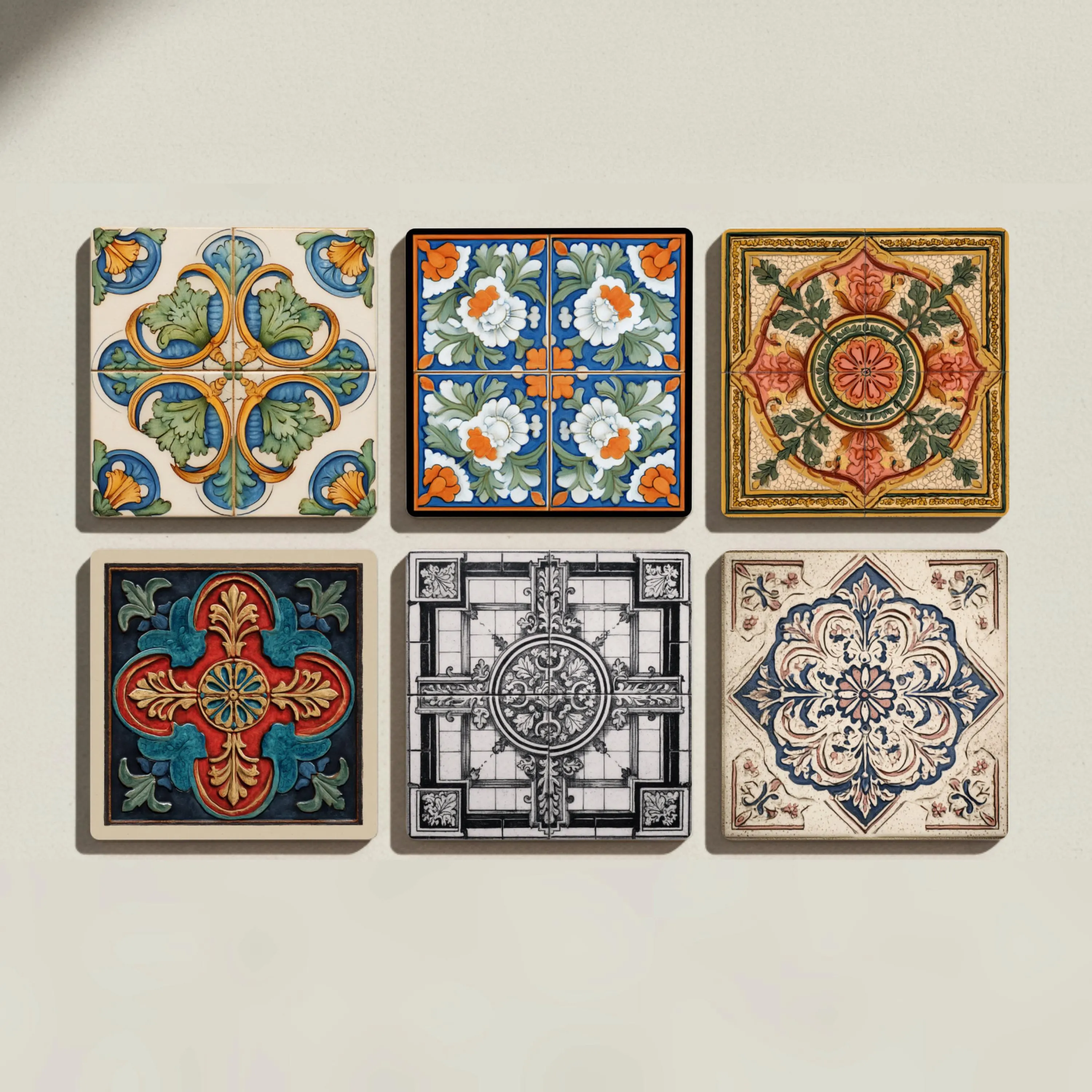
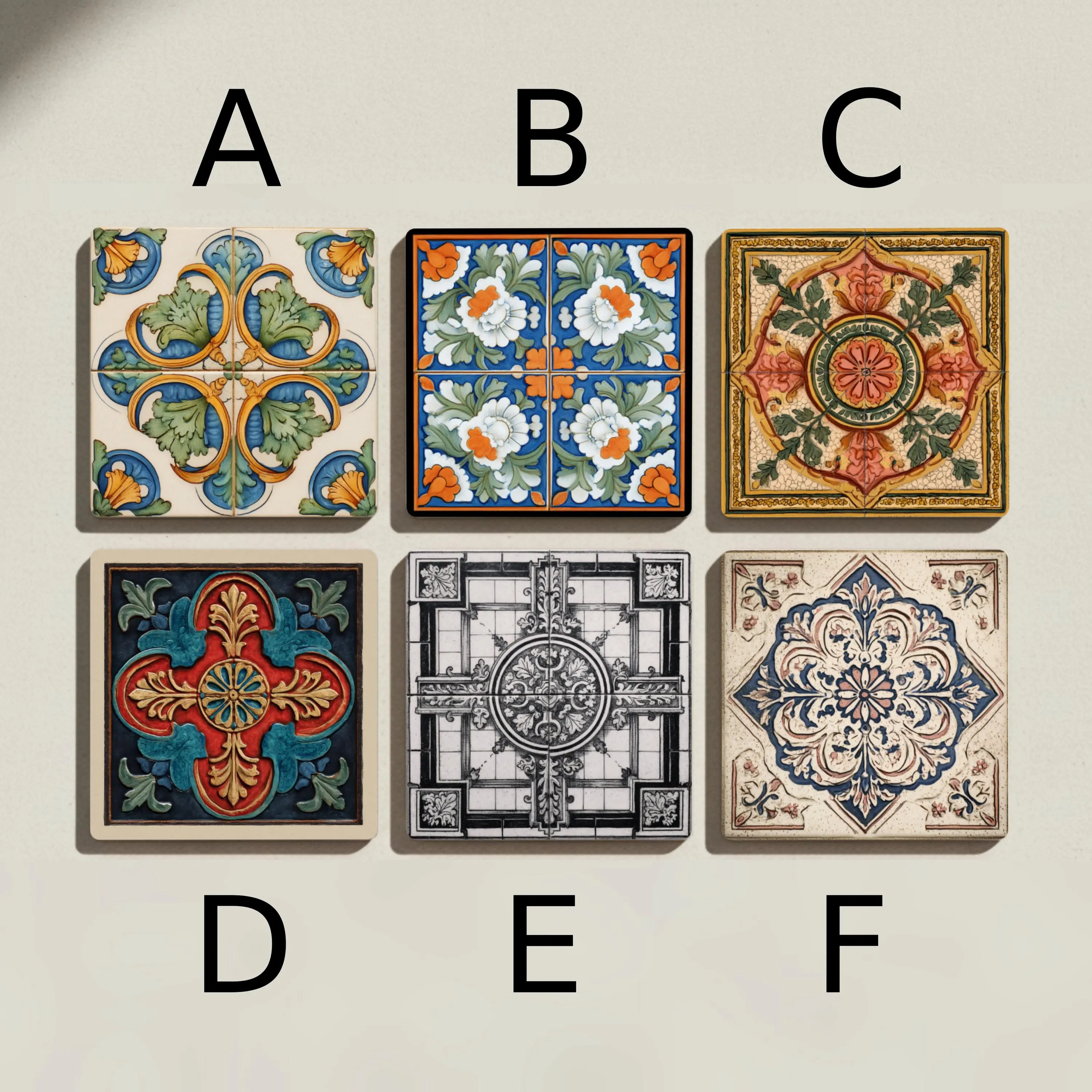
The first coaster reproduces a quatrefoil layout characteristic of Deruta maiolica circa 1500-1540, featuring stylized acanthus leaves in teal and amber forming a cross-axis composition framed by corner fleur-de-lis in cobalt blue. This references the workshop output commissioned by Umbrian noble families for chapel floors and palazzo courtyards. The second interprets a Valencia cuatro (four-tile) pattern from the late Gothic period, showing naturalistic white carnations with saffron-orange pistils against a deep blue ground, bordered by terracotta bands—a design vocabulary that migrated from Manises kilns to Seville and eventually colonial Mexico. The third presents a polychrome Renaissance rosette in the manner of Pesaro or Faenza maiolica, with a central daisy medallion surrounded by foliate scrolls in pink, green, and ochre on a warm ivory ground, enclosed by a geometric meander border that echoes Vitruvian architectural ornament.
The fourth coaster features a bold symmetrical cross in vermillion and gold against a teal-black ground, flanked by sage-green acanthus volutes—a composition recalling the chiaroscuro experiments of late Quattrocento ceramic painters who studied prints by Mantegna and Pollaiuolo. The fifth departs into a grisaille (monochrome gray) Art Nouveau tile pattern from the early 1900s, showing a radial rosette within a grid of stylized anthemion corners, representing the Victorian revivalist fascination with Renaissance form filtered through Glasgow School and Jugendstil sensibilities. The sixth returns to Mediterranean tradition with a symmetrical floral cross in Prussian blue and rust-red tones on cream, its flowing arabesques suggesting both Italian grottesche and Hispano-Moresque mudéjar influence.
The palette adheres to historic pigment limitations: cobalt blue from imported zaffre (smalt), iron-red from ferric oxide, antimony yellow from Naples yellow (giallolino), copper green from malachite, and manganese brown-black. These were applied over a tin-opacified white glaze that gave maiolica its characteristic luminous surface, firing at earthenware temperatures that preserve color vibrancy while creating a slightly soft, porous body. The coaster surfaces replicate this visual and tactile quality—glossy but not glass-like, with subtle crazing that suggests age and handwork rather than industrial uniformity.
On a dining table, these coasters recall the embedded tile panels in Renaissance refectory tables and credenzas. On a coffee table, they evoke the decorative tile inserts in Baroque console tables and the framed tile collections displayed in studioli and curiosity cabinets. On a kitchen counter or writing desk, they introduce the chromatic density and formal discipline of pre-industrial European ceramics, appealing to those familiar with the collections at the Victoria & Albert Museum, the Museo Internazionale delle Ceramiche in Faenza, or the Hispanic Society in New York.
These coasters suit interiors furnished with Spanish Colonial revival elements, Italian Renaissance reproduction furniture, Mediterranean rustic antiques, or eclectic maximalist layering that values historical reference. They pair naturally with terracotta floors, wrought iron, carved walnut, and hand-knotted carpets. The designs also function within Arts and Crafts interiors, where William De Morgan and others revived Renaissance tile techniques, and in contemporary settings where a single concentrated gesture of historical pattern provides visual and intellectual anchor.
Beyond protecting surfaces from moisture and heat, the set serves as a condensed survey of European tin-glaze ceramic history—a craft practice that connected Islamic chemistry, Italian humanist aesthetics, Spanish maritime trade, and the birth of European luxury goods industries. This makes the coasters particularly appropriate as gifts for ceramic historians, Renaissance Faire vendors seeking authenticity, collectors of Talavera or Delftware, travelers returning from Umbria or Valencia, or anyone restoring a period home who requires small-scale decorative elements that feel archaeologically grounded rather than generically "Mediterranean."
🖊️ Personalization
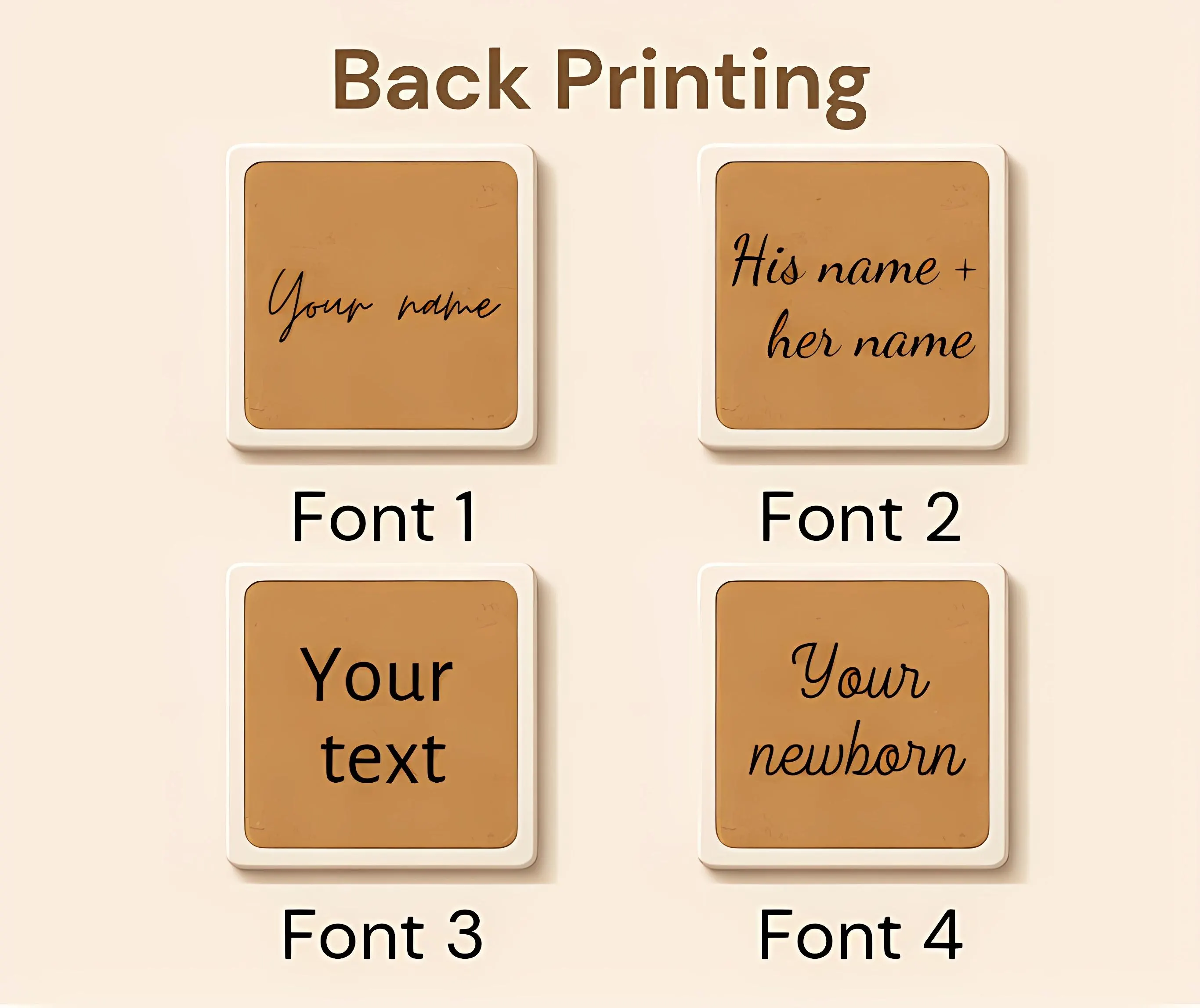
If you'd like to incorporate a Renaissance monogram, a family crest rendered in maiolica style, a Latin motto cartouche, or a date in Roman numerals within a scrollwork frame, I can develop a custom variation that respects the compositional grammar and glazing traditions of 16th-century Italian or Spanish ceramic workshops while maintaining legibility and historical plausibility.